At the Tate — Tracey Emin: A Second Life
In A Second Life, Tracey Emin invites us behind the curtain – or under the sheets – into her life, her loss, her joy and her sadness such that we can’t help but inhabit her experience – from a distance.
Evident in Tracey Emin’s A Second Life, her career-spanning exhibition open through August at the Tate Modern, are the efforts she makes to maintain a degree of separation between herself and the viewer, to challenge her relatability whilst demanding an empathetic response all the same. While we are forced to feel, and feel with her, Emin’s portrayal of herself through her art retains an unsympathetic air. It’s in that conflict that the work shines neon bright, asking what it means to be objectified, what it means to be used or to be abused by others, what it means to be in need and what it means to be needed. From her childhood, through her early adulthood, her traumatic abortion, and subsequent struggles with mental and physical wellbeing, Emin trawls the extremes of individual light and dark and casts it back to us in works that are arresting, thoughtful, and more than a little discomforting.
Through the exhibition, which comprises textiles, paintings, handwritten manuscripts, photographs, sculpture, neon lights, the seminal sculpture My Bed, and even a rollercoaster, a void develops between artist and observer. In the early pieces Emin presents to us her own objectification, and here we find her at her most human. In her handwritten C.V., her actual passport, or her engrossing 1995 film Why I Never Became a Dancer, Emin explores the different ways she has been reduced, in her humanity, either by or for others. The effect is to bring us closer to her, to find her relatable, sympathetic. As we draw deeper into the version of her presented to us – her series of bronzes, her self-portrait-adjacent paintings, and her own Death Mask, Emin moves to objectify – to literally create objects of – herself. Accompanied by stark writing in neon and paint, we find a searing vulnerability, but the effect is to establish distance. We are told ‘It’s Not Me That’s Crying, It’s My Soul’. Should we share sorrow with someone attempting to find distance from sorrow themselves? There is crying here, there ought to be empathy too, but Emin asks us not to feel for her.
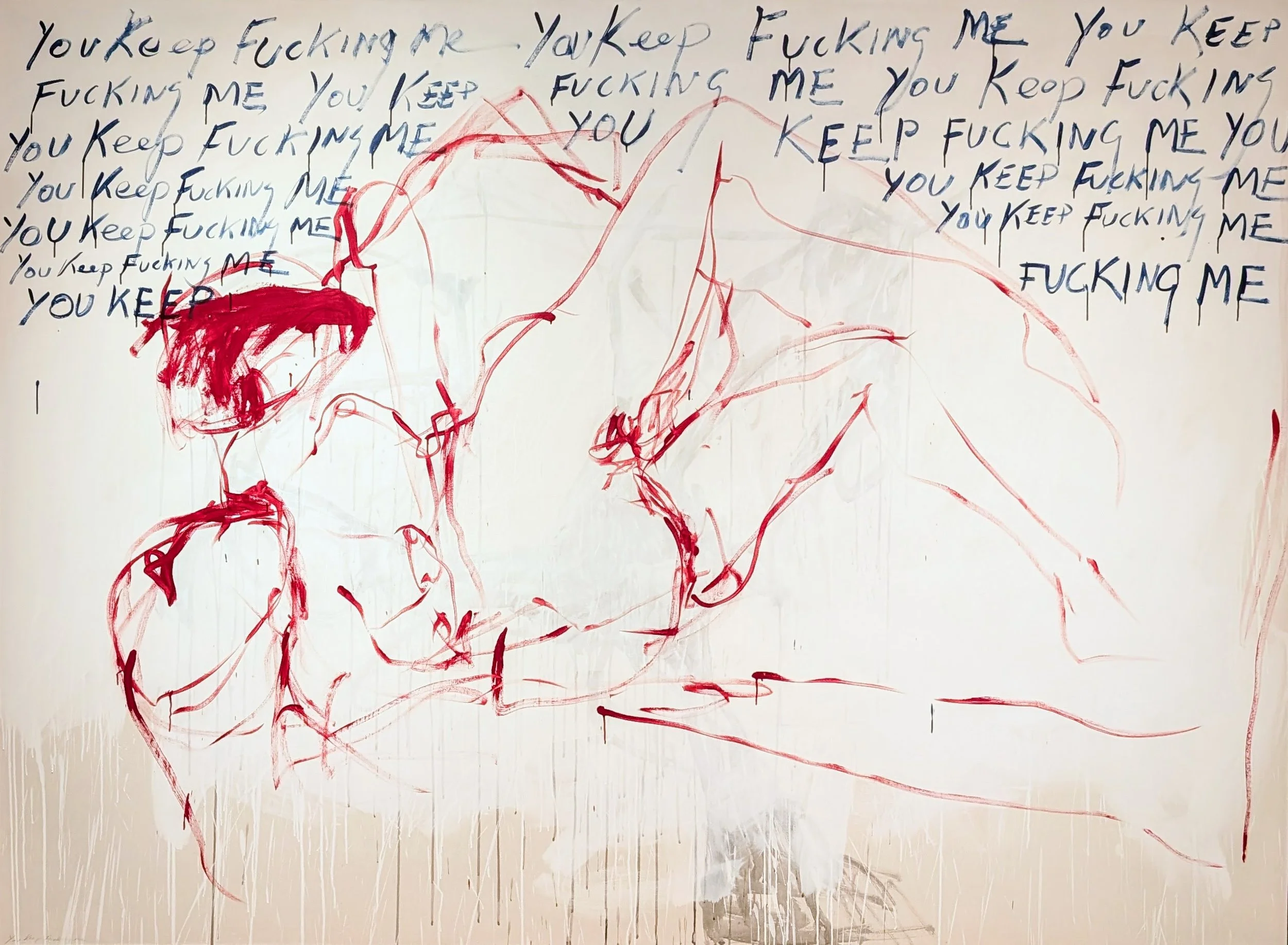
You Keep Fucking Me — Tracey Emin, 2024
The middle section offers some of the more objectively powerful works on show. A video of Emin in the ‘90s describing the horrors of her abortion gives way to her examination of motherhood and her perception of her distance from it. The box room in which she forced herself to return to painting is presented straight, a ‘found art’ installation similar to My Bed that allows us insight to Emin’s struggle, and her process. The claustrophobia here is pressed home further through a subsequent photography series of Emin’s body – bloodied, torn, and augmented with medical hardware post surgery – presented in a long corridor, tight, dark, foreboding.
So it’s through the presentation of her work as much as the work itself that we make our connection with Emin the human beyond Emin the artist, Emin the subject, or Emin the object. The space itself tells us something more, whether that’s in the deep blue paint of the walls or in a candid paragraph positioned half-hidden behind an installation. Emin draws us into these spaces, her spaces, and presents herself to us within them without reservation, forcing us into an emotional response that the work itself doubles down on. We find ourselves in that strange empathy for and because of the inanimate. Through the distance she creates between herself as artist versus subject, as human versus object, she distances herself from us the observer. But it’s this distance that encourages us to reach, to understand. To feel. ⚭
Dan JohnsonTracy Emin: A Second Life is open at Tate Modern, Bankside, London, until 31 August 2026
