Meat on Bread: Cicchetti, Venice
A cultural force across human societies distant in time, space, and outlook. We call it ‘meat on bread’.
In 1814 Lord Byron wrote a letter that said ‘I want to see Venice, and the Alps, and Parmesan cheeses’. Exactly 200 years later I had the same thought, and found myself in Venice for a year. I was there to study, but mostly I skipped my classes in favour of wandering around beautiful backstreets, drinking cappuccinos and Aperol spritzes on picturesque corners next to canals. The Aperol spritz had not yet made it to my home city of London – in a few short years there would be 10-foot-tall bright-orange billboards advertising the italian aperitivo all over the tube, but in 2014, when my friends and I sat in Campo Santa Margarita drinking €2 spritzes out of plastic cups, we felt like we were in on a secret.
To me, Venice felt like it was full of secrets. My first month there I would listen to my iPod as I walked every inch of the island, and the more I walked, the more it mystified me. An island so small you can walk from top to bottom in an hour, but with such an intricate labyrinth of streets and bridges you could find yourself lost, on a completely unfamiliar street, months after arriving. This was also intoxicating, though; to walk around Venice is to brim with the possibility that there’s always something around the next corner, across the next bridge, waiting to be discovered. The biggest mystery of all to me were the Venetians themselves – where are they?,I thought, and in a city that’s more tourists than locals, how do you find them? But I walked more, down tiny calli and under sotoporteghi, further into its dense fabric, and I found them. The Venetians were deep in the maze, gathered outside tiny bars, paper plates piled high with small bites of food I’d never seen before: cicchetti.
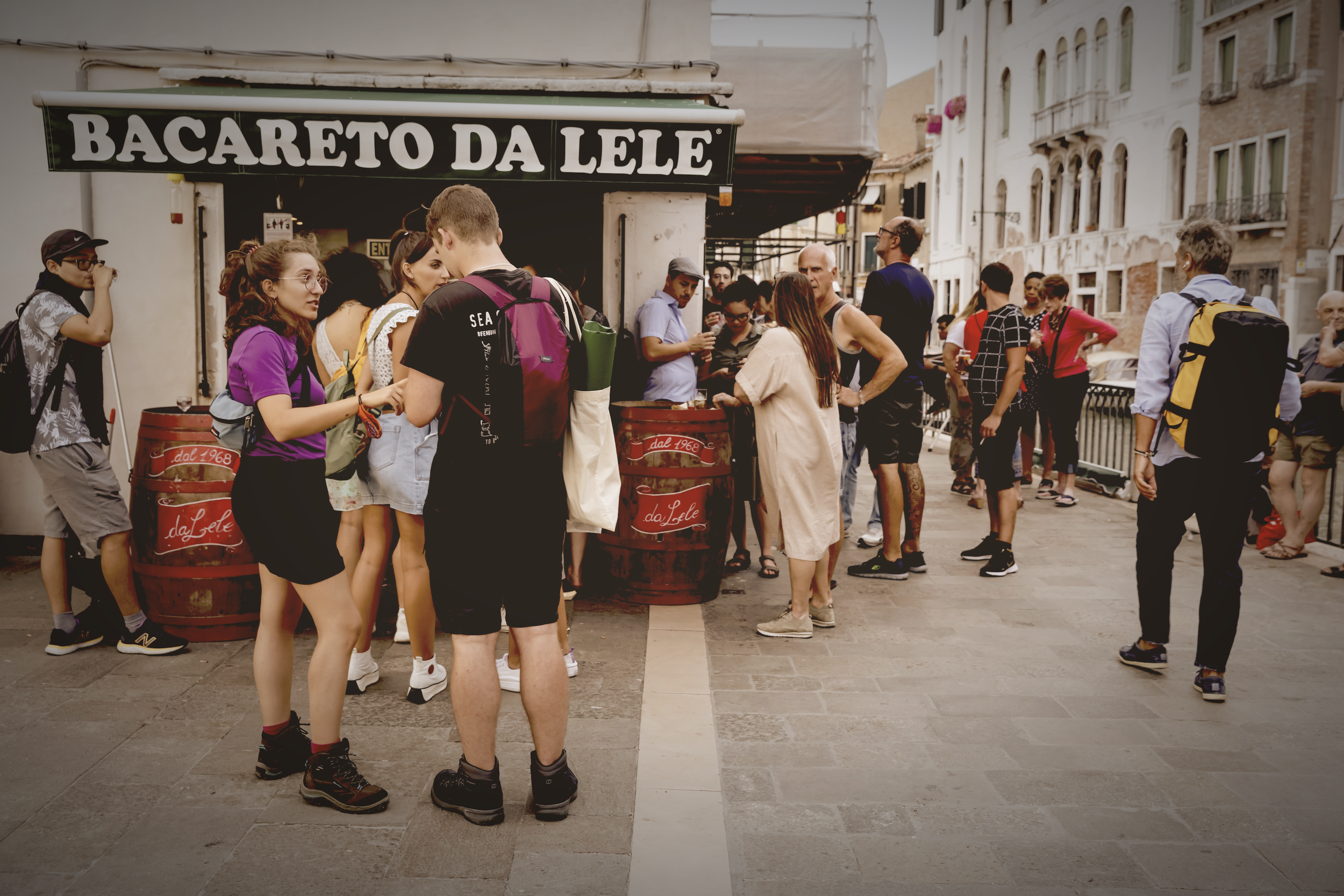
Cicchetti is Venetian bar food, akin to tapas, most commonly consisting of meat, seafood or vegetables laid on top of a slice of bread or polenta (called crostini). But it’s also meatballs (polpette), tiny sandwiches (tramezzini) and assorted fried food (fritto misto). It’s typically eaten standing out on the street, on paper plates or even just napkins, and is always accompanied by a wine. You can’t really find cicchetti elsewhere in Italy, and in a world where Aperol now dominates summer drinks menus across the UK, cicchetti seems to have remained one of the more well-kept secrets in the 12 years that have elapsed since my Venetian sojourn, as elusive as the Venetians themselves.
Culture, lifestyle, ritual, history, and humble to boot.
My friends and I became obsessed with cicchetti during our year there. Though we were, in hindsight, not great at living in Venice, we longed to be Venetian, to live as the Venetians did. And what was more Venetian than cicchetti? It is not just deep-fried seafood and things smeared on bread; cicchetti is culture, lifestyle, ritual. Groups of old Italian men gather outside All’Arco in Rialto at 10 am on a Monday, as though it’s their job to stand there, eating baccala and drinking prosecco. Cicchetti is history; it dates back to the 13th Century, when merchants and sailors would grab quick bites in between trading. Cicchetti is humble; it’s quick to prepare and costs between €1 and €4 for each bite. Venetians cannot imagine coming home after work without debriefing with friends at a bacaro over these small mouthfuls.
One day, as Spring and the promise of warmer weather approached, we concocted an idea. ‘Like a pub crawl’ we said, ‘but we eat at every place’. I’m sure, with the self-assured confidence that only a group of 20-year-olds can have, we thought we’d invented this ‘Cicchetti Crawl’ – but of course Venetians have been doing it for centuries. We constructed an elaborate route through Venice, starting right near Piazzale Roma, the bus station through which people enter the city, and moving through almost all the sestieri – the six neighbourhoods of the island. Our first spot was Al Timon in Cannaregio, where you take your plates onto a small boat, and eat floating on the canal. Then to La Cantina on the Strada Nuova, where a friend bought me my first oyster – ‘When Casanova lived in Venice, he ate 50 oysters from the laguna for breakfast every day’ – he told me. Be Venetian, I thought, before I tipped the oyster down my throat, practically choked on it, and coughed it back up.
Though my Italian was still limited, I had learned how to say ‘one of those, two of those’, and as we moved from bacaro to bacaro, I pointed at the glass cabinets of crostini to the ones I wanted saying ‘uno di questo e due di questi, per favore’. We moved from Cannaregio to Rialto, paying €1.50 to ride the traghetto across the grand canal. There, we hit Al Merca, All’Arco, Cantina Do Mori and Cantina Do Spade. We crammed into narrow calli alongside the Venetians, eating deep fried olives, polpette, and various meats on various breads – mortadella and pesto, speck and brie, prosciutto and truffle cream. Vegetarian offerings, too – gorgonzola and walnuts, roasted red peppers, artichoke cream; and, of course, seafood – sarde in saor, and the famed baccala (creamed cod).
At Enoteca al Volta, allegedly the oldest wine bar in Venice, my Italian friend taught me a Venetian phrase, ‘l’acqua marsise i pai’. It means ‘water rots the poles’ – referring to the wooden poles that keep the city afloat – and the implication, she told me, was that drinking wine was better. We repeated the phrase to each other as we moved through Castello, and back round to Dorsoduro, cheers-ing to it each time we bought another round. Our crawl ended at Cantine del Vino già Schiavi, which was a frequent haunt for students at my university, Ca Foscari. Years later, I saw Stanley Tucci visit Schiavi on his TV show Searching for Italy, and through a painful pang of nostalgia, thought maybe we really were onto something in 2014.
I turned 21 the year I lived in Venice. Youth is wasted on the young, and I spent far too many days hungover in my San Marco bedroom, the green shutters on my window fully closed, cursing the church bells that rang through the city for waking me up. I never made it to the famous Rialto fish market, nor to the Venice Biennale which ran the summer I was there. Neither I nor any of my friends spoke amazing Italian. But when we flooded the streets outside the bacari, our plates piled high with cicchetti, and our prosecco glasses overflowing, we had unlocked the secret, we’d solved the labyrinth – we were Venetian. ⚭
Cat FarrellMore 2G4