The Kindness of Strangers
After a week in the Big Easy, Tom Galvin reflects on the people, hospitality, and iconic food & drink of New Orleans.
All our fried seafood is spicy is written in large chalk handwriting on several warning signs in the deli. I am further asked if spicy is okay by the woman at the counter when ordering a dressed crawfish po'boy off the handpainted technicolour menu on the wall. ‘Ya’ll got a accent, where y’all from?’ she asks me in a Southern drawl. In my experience Americans on home turf are not at all shy about asking this. Even if you are overheard talking, bystanders will turn around to ask where you’re from. I’d always associated this with a mild cultural xenophobia over there. To be fair to the yanks, I’ve never been asked this particularly rudely, or made to feel unwelcome when I answer, but another part of me attributed this to the fact I am white. In New Orleans, when folk enquired about my provenance I didn’t feel this undertone to the question, it seemed people were genuinely asking as a conversation starter, excited to meet someone new and different. I chatted to the waitress a bit about Manchester and the UK, and 5 minutes later a guy comes from the kitchen with a paper wrapped po’boy for ‘Tam’. The signs didn’t lie. 31°C and 80% humidity, I did not think it was possible for me to sweat more but a few bites of the chewy baguette proved me wrong. The crawfish tails were juicy and snappy, steaming from their crunchy flavourful cajun batter, the heat (and temperature) tempered by the ‘dressing’: crisp cool shredded lettuce, tomatoes and pickles, with a hearty slather of mayo. I add some Louisiana crystal hot sauce for good measure and push myself into eccrine overdrive.
As a gourmand, I always try to sample as much of the local fare as possible when on holiday or even better on a work trip (i.e., on expenses). For work, this is often easier when I’m on my own: I’ll happily schlep half-way across Boston for the original Roast Beef sandwich solo, but this sort of thing is harder to justify to a tired and hungry colleague that just wants to eat anything around the corner. In New Orleans, Louisiana, I have my work cut out for me. The state and the city boast a tremendous amount of traditional foods and drinks quite dissimilar to other American cuisine. Not one but two famous sandwiches: I was shocked when I was told by a stranger in a bar that the muffuletta (surely an invention of the delis of New York, no?) was a NOLA original. I ordered one (well, a half, they are massive) from a small convenience store with a kitchen in the back one evening on the way back from the bar. It was a spicy variant, cayenne in the olive salad and pepperjack cheese. There’s no seating in the store so it was consumed on the street, sitting on a step outside someone’s home in the french quarter in the thick humidity. Despite the diminutive name, even half of one is a formidable meal. Around me are several jazz bars in earshot (this is essentially true wherever you are on Bourbon St) whose disparate intermingling melodies form a powerfully discordant sort of Hyperjazz that the likes of Kidd Jordan would have gone mad for. But that sums up what I’ve seen of the city, an eclectic mishmash of different cultures and people and even time periods. Revered music clubs and haughty historic hotels rub shoulders with strip clubs and awful looking neon chicken shops with AI slop signage. A true melting pot.
“31°C and 80% humidity, I did not think it was possible for me to sweat more but a few bites of the chewy baguette proved me wrong.”
I travel a lot for work and often alone, and quite enjoy chatting to local randoms (which is not how I behave in the UK, but needs must I suppose). Obviously no group is monolithic, but generally the people I try to talk to from a given city behave similarly. Some places people look at you like a nutter or ignore you. Others have people who are friendly and welcoming and up for a chat, Ljubljana being a great example of the latter; baristas and waitresses actually sitting down with me mid-shift to discuss specialty coffee or the local skin-contact wine in great depth once they realised I was genuinely interested (and not in a way that felt like I was being milked for a gratuity). New Orleans goes one further, where I merely need to enter an establishment and order something in my Southern (English not American) accent and all sorts of people come out of the woodwork to try and chat to me.
We ask that you please pre-order this as your second drink reads the menu. Having already tried the legendary Sazerac the night before, I opt for a negroni while I wait for my Ramos gin fizz. The bartender asks (after enquiring where I’m from) that I give her 20 minutes or so to fulfill some other orders but that she’ll grab me when my second drink is ready. Despite the glorious air-conditioned interior, I opt to sit outside in the swampy mugginess. The Ramos gin fizz is arguably as legendary to NOLA as the Sazerac but I have had to seek a place out with it on the menu for the single reason that it’s a pain in the arse to make. On top of the traditional gin fizz ingredients it contains cream, egg, orange blossom water and requires 10 or so minutes of sustained shaking to form a thick meringue-like texture. I’ve cheated when making these at home by building the drink in a cream whipper and letting the nitrous oxide do the work, but not so here. While I wait I get chatting to a woman sat next to me, who asks me for a lighter before clocking the accent and locking in for the origin chat. She’s a bartender/server at a couple of places and there is some humorous confusion around my job (‘I thought you said you worked in the industry too?’ ‘No, just industry’). I get her local food recommendations, we have a jovial debate about whether a beignet is a doughnut or not (it is), before she leaves to go to her friend’s DJ night round the corner. I am invited to the event with an openness disproportionate to our time knowing each other. No sooner had she left before the woman at the next table (who had overheard my accent and was awaiting politely her opportunity for a chat) asked me where I’m from (as much as I’d like to say something about women in bars queuing up to talk to me, that was definitely not the vibe in either case). She’s also here for work, from Atlanta, but spends a few months of every year in New Orleans, her favourite city. She is white, and apologies profusely for Donald Trump. That leads nicely onto a discussion of New Orleans’ history with the slave trade. We’re sat more or less opposite Louis Armstrong Park, and Congo Square, the jubilant and defiant history of which she shares with me. It’s important to own your history, she says, not shy away from it or pretend it didn’t happen. Understand the bad with the good and do what you can to make things right. Coming from England I tell her I know a thing or two about this as well. Just then the bartender summons me for the final step of the RGF. A small hole is made in the thick meringue floating on top of the drink and soda water is poured slowly down an inserted Hoffman barspoon, causing the luxurious foam to rise high above the walls of the glass. They say a good Ramos gin fizz should be able to support a straw upright in the foam. I have no doubt this one could support the barspoon. It is sherberty and refreshing and surprisingly light for something with cream and egg in it.
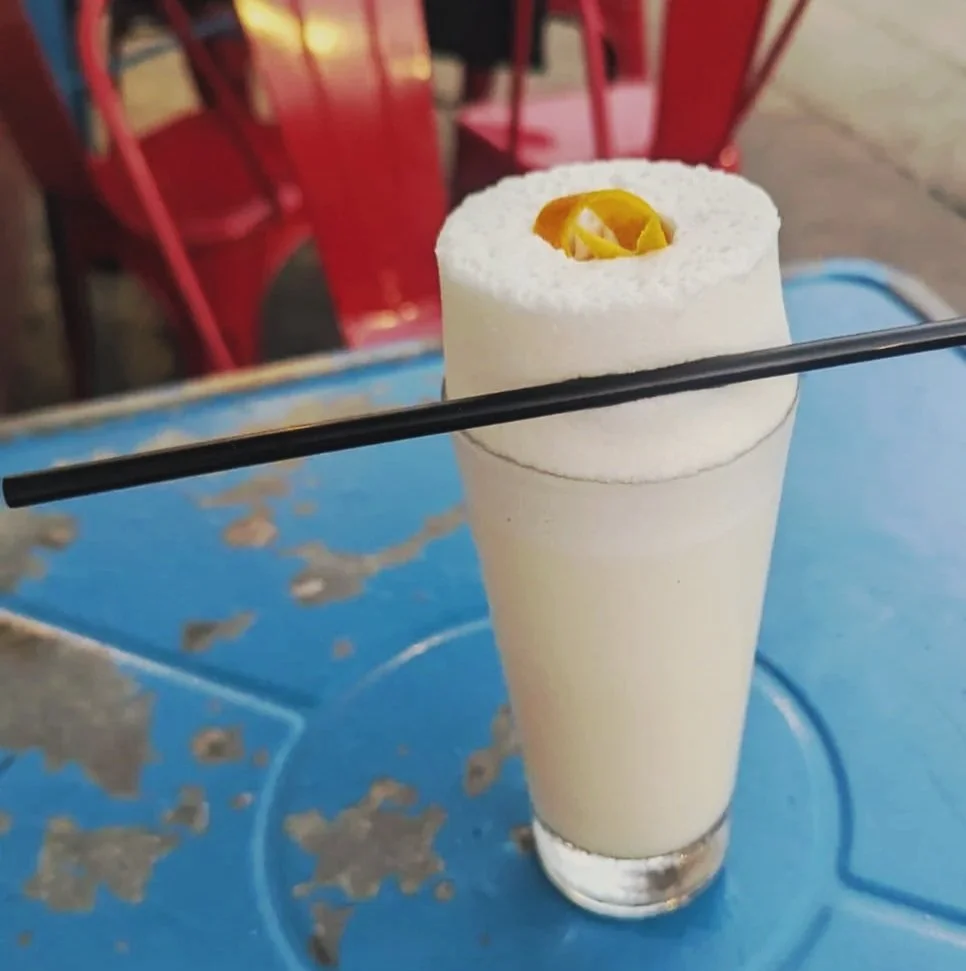
NOLA’s famous Ramos Gin Fizz. Photo: Tom Galvin
Spectacle over I return, drink in hand, to chatting with the woman outside. I of course get her local eatery suggestions, and she says she considers Louisiana creole cuisine the only true American food (meaning the USA), far less recognisable as bastardised European dishes that make up a lot of classic US fare. No shade on this woman at all, but I think this neglects the massive influence that West African cuisine, via the slave trade, has had on the local delicacies. I actually don’t think this invalidates her point though. You might see a link between jambalaya and jollof rice, gumbo and okra stew, but the connection is far more tenuous than, for example, pizza Napoletana and pizza from Detroit. It is probably fairer to say that Creole cuisine, like the city, is a true melting pot of African, French, Spanish and indigenous peoples’ culinary influence, and the result is something unique, sui generis but not shy about where its roots lay.
I eventually leave the bar after a few more cocktails and say a friendly goodbye to both the stranger and the bartender and stumble back towards the hotel. It’s been a tall order, but my checklist is doing well. Gumbo, Jambalaya, Etoufee: tick. Po’boy and Muffuletta: tick. Beignets, hot sausage, breakfast with grits: tick. Alligator nuggets: tick. A mammoth seafood boil that easily defeated three of us: tick. Boudin balls, red beans and rice are a tick. Tomorrow I will seek out dirty rice and then will have hit most of my non-exhaustive list. Not bad. At that moment a friend responds to my instagram story, realising where I am. ‘Have you tried Voodoo chips (crisps)? Or a hand grenade?’ Fuck. No rest for the wicked, I ambulate back into the French quarter, having seen people wandering the streets at all hours (open container laws are somewhat lax in NO) with luminous plastic hand-grenade-shaped bong things. I order one to go from one of the 5 bars licensed to make ‘New Orleans’ most powerful cocktail’. Originally entirely spirit (including 180 proof everclear type stuff) and liqueur-based (I’m pretty sure there’s some fruit juice in my one), it’s a far cry from the elegance of the Sazerac or the whimsy of the RGF. It tastes like melon and isopropanol, and its imbibement significantly increases the difficulty I have in navigating myself back to the hotel. Against all odds I feel alright the next day, and manage to secure some Zapp’s New Orleans Voodoo flavour kettle chips (crisps). In another melting pot city, Glasgow, in Scotland, pakoras (typically chicken) reign supreme as the end-of-night drunken snack. Every kebab shop sells them there, and they are served with the ubiquitous ‘pakora sauce’; an opaque pinkish emulsified concoction. It’s minty and tangy and creamy and spicy and zingy, and to my taste is just all of the usual kebab shop sauces mixed into one, probably all the ends of squeezy bottles for economic reasons. Voodoo chips (crisps) are the chip (crisp) equivalent of this, tasting like all the common chip (crisp) flavours mixed together. They’re great, an eclectic flavour sensation gestalt that keeps just to the right side of overstimulation, much like the great city itself. ⚭
Tom GalvinNOLA Po’Boys is open Monday—Sunday, Bourbon St., New Orleans
Bar Tonique is open Monday—Sunday, N Rampart St., New Orleans
More 2G4