Festa Major
Across Catalonia, the rhythms of daily life are broken once a year through deliberate acts of belonging.
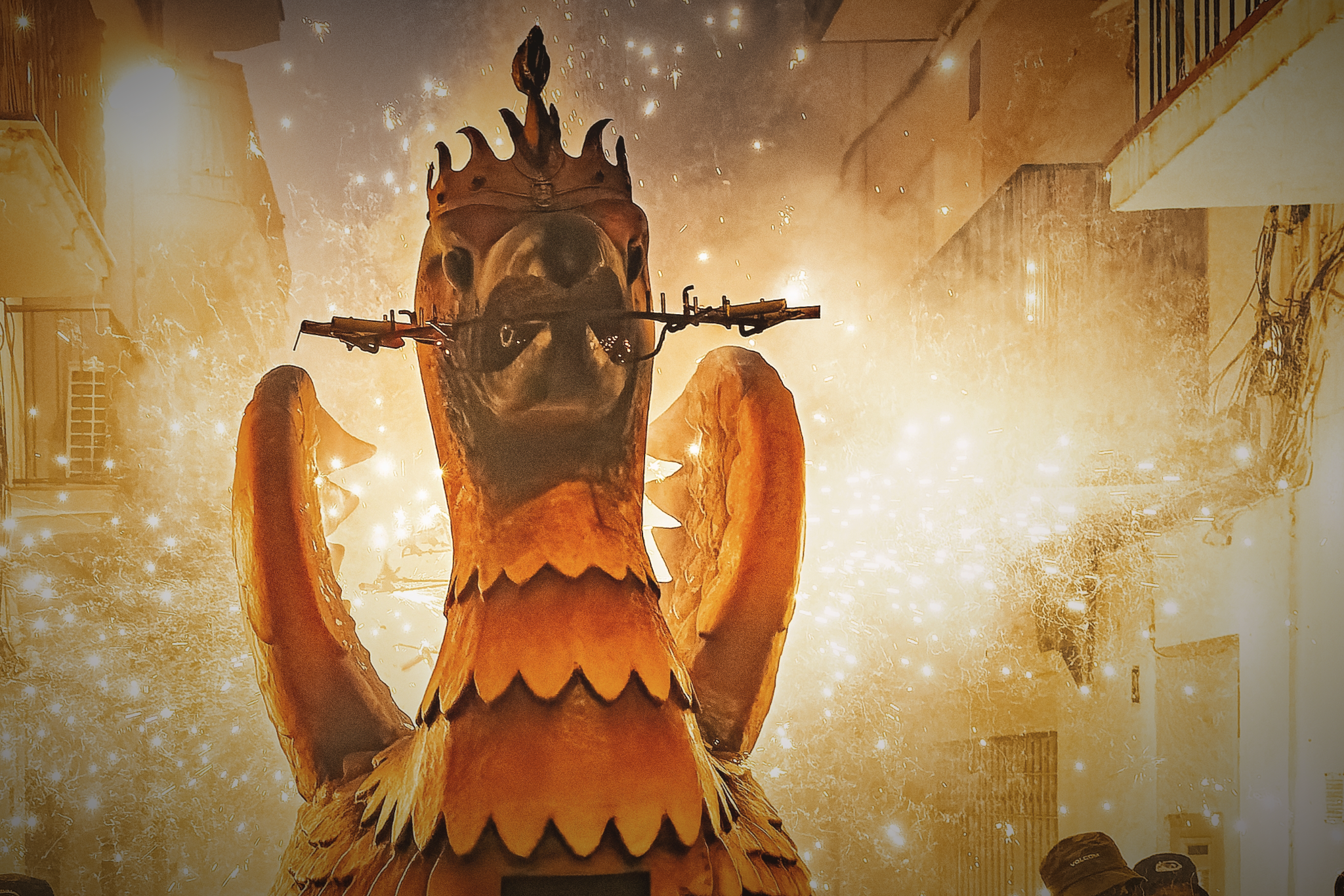
Picture this: you’re taking a stroll through the city with the summer sun beating down on you. A group of old Catalans are sat gossiping on your left and on your right, dog walkers have stopped for a catch-up while their beloved pets get some much needed relief. There is a sun-stroked calm in the air against a backdrop of tree-lined streets, the trees providing essential moments of shade as the beads of sweat begin to gather on your forehead. The deep sense of peace feels almost paradoxical when you’re strolling through a bustling European city. Suddenly, you’re drawn to the sound of a distant, persistent drumming which is, to some extent, unsettling. As curiosity gets the best of you and your feet draw you closer to the percussion, there is an added cacophony of small explosions which can only mean one thing: World War III. Rather than running for your life to alert your loved ones, you convince yourself it cannot possibly be the end of days yet – surely not before Dune 3 is released in cinemas. So you pick up the pace and move towards the sound of drums and explosions. Shouting and loud voices are heard and more people emerge forming small crowds, moving in the same direction as you (are they mad?!). You move with the crowd, turn the corner, and there it is. Fire in the squares!
For the uninitiated, you’d be forgiven for wanting to dial for emergency services and send for help. But this is Festa Major (FEST-a mash-OR). You don’t need help. This isn’t an emergency. It’s a celebration. A cultural institution.
Festa Major is a Catalan phrase that means ‘local festival’ (or, historically, ‘major feast’), and it extends as far back as the 14th Century with more than 900 events taking place across Catalonia every year. Its origins have religious connections, celebrating the patron saints of local communities. Nowadays, God and her saints don’t haunt the parades and festivals like they used to, but the spirit of the event remains steadfast with communities gathering in their streets to proudly consolidate their individuality and local identity. Neighbours eat together. Dance together. Create art together. Celebrate together. The common street and neighbourhood becomes itself a Third Space and Festa Major magically transforms the function of everyday places. A street that normally serves cars and traffic becomes an al fresco dining room, a local community centre becomes a dance floor with DJs and local artists, and a neighbour’s front door forms part of the set design for staging acrobatics and showcasing giant papier-maché sculptures. A neighbourhood square, usually a simple thoroughfare, is now alight with literal fire: a space for gawking at huge bonfires, lighting fireworks, and throwing fire crackers at one another (more on that and the obsession with fire later).
There are two very unique components to Festa Major. Firstly, that belonging is something you do rather than something that happens to you. You don’t simply attend your local Festa Major, you organise it. Neighbours chop, peel and cook the ingredients for large communal dishes together - whether it’s paellas in giant pans or hundreds of sausages and calçots on the barbecue – the taste of community and togetherness is savoured by everyone. And if cooking and performing is not your thing, worry not – you can put your hand to the communal crafting of giant men and women that will be paraded through the streets, or simply decorate your balcony and front door step with bunting. Still not convinced? Wait for the sun to set, grab some devil horns, and run around hysterically with fire in the Correfoc.
Secondly, and perhaps most importantly, there is a temporal dimension to Festa Major. The celebrations last many days, and as such interrupt the typical rhythm of life. The monotony of work and commuting and domestic responsibilities is disrupted by friends and families eating later into the evenings, children playing together for longer after school, a whole neighbourhood of people marching through the streets together behind the band en route to one of many stages. And when they’ve reached their destination? They dance. They drink. They love. That ordinary day of yours becomes a little extraordinary. And it’s this disruption that creates connections and strengthens relationships long after the party is over.
There is a wonderful chaos to these local festivals which is amplified by fire. Mostly because the little devils (ball de diables) who join the party spinning fire in the air like they just don’t care reflect just that: bringing organised chaos into the heart of the community. There is no standing behind protective barriers. It’s an intimate performance between actor and spectator. A dangerous and exhilarating experience is made safe based on a collective understanding, respect and trust in one another. The fire holder knows how to manipulate the fire. The spectator knows where to run and how to move around the fire. These few minutes of maddening spectacle, compounded by children throwing fire crackers at the feet of their defenceless grandparents, bring such joy to these short-lived Third Spaces. And with the addition of (controlled) bonfires in squares that add a ritualistic and hypnotic element, the closeness with the people around you is felt ever more deeply late into the night.
The ceremonial aspect to Festa Major is enhanced by the musicality of the people. A percussive calling to neighbouring towns: this is our time, now. A rhythm and beat that accompanies the communal activities throughout the day and quite literally, to quote the greatest mnemonic of all time, has your two hips moving. That same rhythm draws people in and before you know it, you’re marching down the street, beer in one hand, neighbour in the other, relishing the noise and spectacle with your amigo. When the march and drumming is over, the attention quickly shifts to Jordi and his band conducting last-minute rehearsals ahead of performing the soundtrack for the night. The rhythm now accompanies every movement and action you make. The joy and energy is palpable.
So what lessons can be learned from all of this? I have a burgeoning paranoia about the end of the world? Some people just have no respect for fire safety? I love Denis Villeneuve's Dune saga? No.
In a world of instant gratification and an increasingly fickle attention economy, the days during a Festa Major implore us to take stock of what really matters in life: community. To remember and celebrate who we all are within that community. To say Hi, how’ve you been? to that neighbour you haven’t spoken to in months. This is the purpose of Festa Major. And for that reason, surely we can dismiss the dangers of playing with fire for the sake of having a little fun, and being free of life’s burdens, together. ⚭
Kevin EastwoodMore 2G4