Times Like These
A conversation with podcaster T. Kyle takes in Paris, London, and his NYC home to rediscover the art of existence.
The conversation begins, unexpectedly, with toilets. T. Kyle laughs as he says it, but he’s completely serious. “Once you’re out in New York,” he tells me, “it’s more of a planned experience.” For someone who grew up on the New Jersey coast, just celebrated their 20th anniversary living in New York City and recently found himself captivated by Paris, it seems an odd place to begin comparing three of the world’s great cities. Yet what starts as a discussion about public bathrooms leads on to cafés and parks, benches and community gardens, nightlife, public infrastructure, and the strange beauty of simply sitting still. Somewhere between New York and Paris, it becomes obvious that toilets were never really the subject at all. They’re just one of the easiest ways to tell whether a city expects people to stay.
T. Kyle is the American creator, producer, and editor of the pop culture Legends Only podcast and the 2018 limited podcast series It’s Britney, Bitch! He’s a pioneer of digital third spaces and all their trappings, also creating the popular GIF Tumblr RealityTVGIFs whose content you may be familiar from one or more group chats, perhaps without knowing it. But it’s not digital spaces we’re talking about today: inspired by the lyrics on Addison Rae’s debut album, T. Kyle embarked on a trip to Paris and London in 2026, which was to change his perspective on cities, who they’re for, and how we exist within them.
But we start with New York, and toilets. I remember walking around Manhattan on a recent trip there, and unknowingly adopting a strategy familiar to many New Yorkers: if you find a public toilet, use it. You might not see another one for hours. T. Kyle laughs when I tell him. “Exactly. You can’t just pop home. Once you’re out, you’re committed.” It’s a tiny inconvenience, but one that shapes the way you experience a city. Where can you sit? Where can you stop? Where can you spend an afternoon without being expected to buy another coffee?
These are questions at the heart of third spaces: the places outside home and work where we hope to meet, socialise, and simply exist. Increasingly, those spaces feel conditional – as our capitalistic society puts a focus on profit over wellbeing. You can sit here if you’re a customer. You can meet, but don’t stay too long. You can socialise, provided you behave in the prescribed way. You can exist, but only if you’re consuming.
Growing up in New Jersey, T. Kyle barely had to think about third spaces because one of the best imaginable was already on his doorstep. “The beach was just... there,” he says. “That was the third space.” Children cycled there after school. Families gathered at weekends. Nearby parks became football pitches, basketball courts and places to waste an afternoon. Nobody checked whether you’d bought anything or asked how long you planned to stay. Moving to New York changed that relationship with public space.
For all its energy, Manhattan rarely encourages stillness. “It’s a walkable city,” T. Kyle explains, “but because you rely on public transport and everything takes planning, you think differently.” One thing particularly struck him: the lack of places to sit. Even where benches exist, they can be interrupted by metal armrests and other examples of hostile architecture designed to prevent people lying down. A bench isn’t just somewhere to rest. It can be a statement about who is welcome to stay. Then T. Kyle went to Paris.
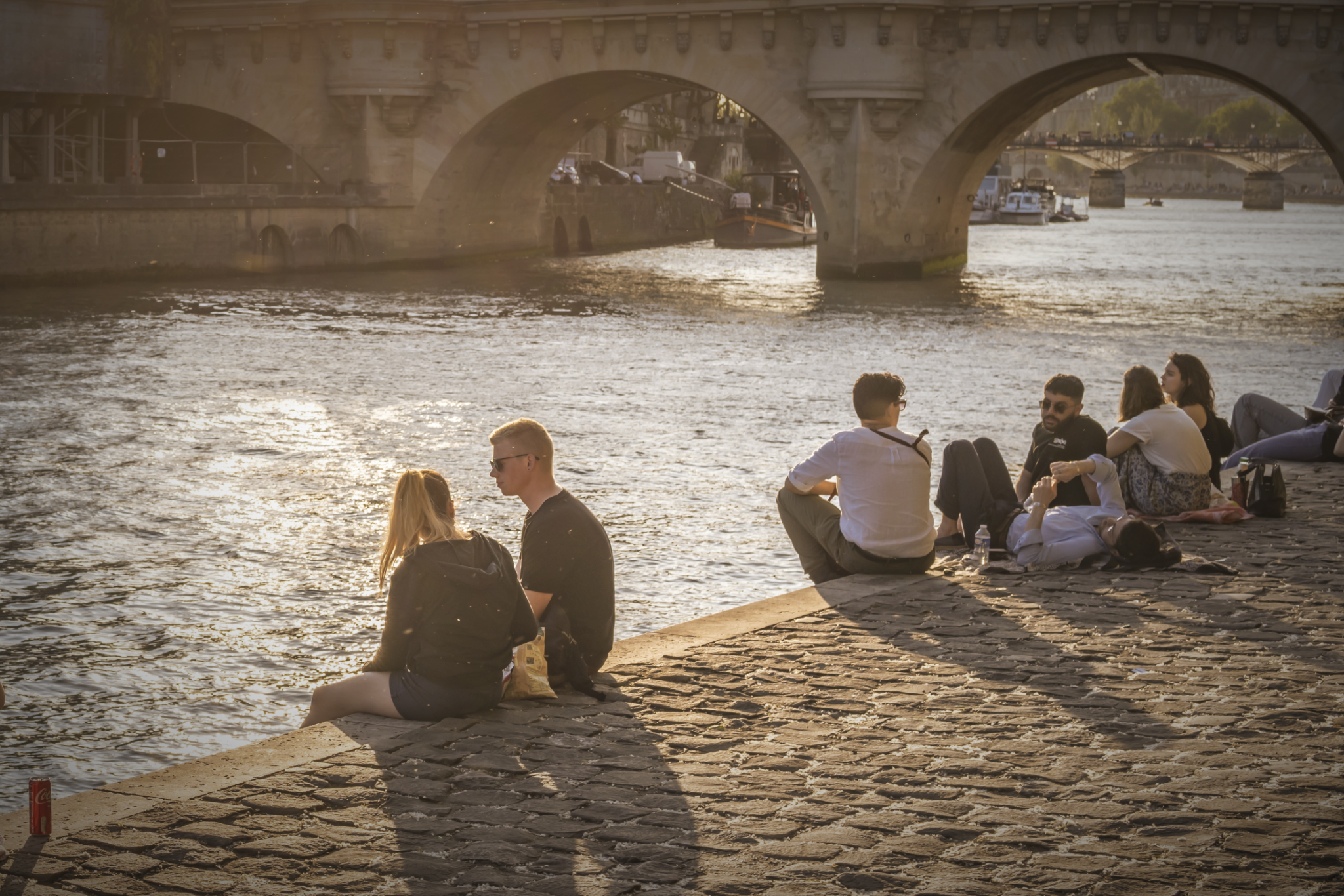
“Along the Seine, groups of friends spread blankets by the water. Nobody seems particularly concerned with moving on.”
Among the architecture, rich in its history and beauty, it was the freedom that really stood out. Along the Seine, groups of friends spread blankets by the water. Bread, cheese, and bottles of wine appear; students sit and talk long after sunset, couples sit against bridges and stone walls. Restaurants spill onto pavements, cafés remain occupied into the evening. The river itself becomes a social space – nobody seems particularly concerned with moving on. “It’s not necessarily about being out really late,” T. Kyle says, “the city just feels alive.” And that’s it: a city isn’t alive because everybody is rushing around, always with somewhere else to be. It’s alive when people choose, and have the freedom, to stay.
Our conversation keeps returning to one word: permission. Paris gives you permission to linger. In New York and London, it often feels you are given permission only to hustle, to commute. These are not absolute truths, but they describe something about the emotional experience of each city, and that experience is often about comfort in occupying a place without having to justify your presence. A public toilet is permission to stay another hour. A bench is permission to pause. A riverside wall can become somewhere a friendship unfolds over an evening without anyone expecting payment.
As a teen, T. Kyle would spend evenings working on homework in coffee shops with friends. A few weeks ago, near his brother’s home in New Jersey, the local Dunkin’ Donuts put up signs saying teenagers were no longer allowed to gather inside and all indoor seating was removed. “They’d banned them from hanging out,” he says. I just thought, What? That’s crazy’” Even in spaces where there’s an expectation of payment, there’s an increasing tightness on permission. The whole thing points to a lack of trust.
Back in Brooklyn, T. Kyle explains, there are waterfront areas where wildflowers and native grasses have been allowed to grow freely. There’s a sign explaining that this is intentional, as though the city needs to reassure people that nature hasn’t appeared because somebody forgot to mow it. In Paris, he noticed less need for explanation. Some gardens are immaculate; others feel softer and less controlled. The city appears comfortable with allowing nature itself to occupy its space, there’s an inherent trust there that’s apparent in both how the plants propagate and in how they are presented to the people. The result is that trust is established in both directions: the city’s relationship with nature is a reflection of its relationship with its people.
Walking beside the Seine, it’s difficult not to wonder why we so rarely create places like this now. But of course, the answer is money. Development, in a construction sense, costs. It needs clients that can foot the bill. Those clients, in turn, need customers who are paying. It follows that if we want new things, in a third-space sense, they must be based around spend, custom, and turnover. From a business perspective, lingering can be inefficient, but from a third space perspective, lingering is the entire point. A three-hour conversation might generate little revenue, but it could create a friendship.
By the Seine. Credit: Shutterstock.
There’s a cycle at play. With fewer spaces built with loitering inherent to their purpose, we are forced inside, to isolation, or online. With more time online, we see less need for the development of new physical communal spaces, and the financial demands on those that do exist become even greater. T. Kyle jokes about Marie Antoinette. “She wasn’t scrolling TikTok all day. She had time to build herself a garden.” For all the obvious problems with romanticising the past, it raises an interesting question. When future generations look back at our era, what public spaces will define it? Another luxury apartment tower? Another shopping complex? Another glass office block? Or places built simply because people deserve somewhere to gather? Social value doesn’t always fit neatly onto a balance sheet.
It’s possible to break the cycle, but only through intent, and action. T. Kyle tells me about a community garden in his New York neighbourhood occupying land developers would happily transform into apartments. Every few years another battle begins. Residents organise, campaigns emerge, and developers circle. “They fight for that stuff,” he says. It’s somewhere neighbours can become neighbours rather than strangers living behind adjacent doors. The fights to protect these spaces suggest people haven’t stopped caring about community, or about infrastructure that facilitates it, which can so easily disappear. Public investment can be a tonic to the poisons of private equity. NYC Mayor Zohran Mamdani recently made a handful of sports pitches open to locals around the clock. Within days, videos appeared online showing people playing in the early hours. “It’s almost like,” T. Kyle laughs, “when you build something for people, they actually use it.”
In London, the story of The Black Cap in Camden is perhaps one of the clearest examples of just how much a third space can mean to the people who use it. The legendary LGBTQ+ pub and cabaret venue closed in 2015, but its community refused to accept that its story had ended. For more than a decade, the #WeAreTheBlackCap campaign fought to protect the venue, keeping its name, history and importance firmly in the public eye until it finally reopened in March 2026. What makes the campaign so significant is the cause: people were fighting for more than just a place to buy a drink. The Black Cap is a place where friendships are formed, performers find a stage, identities explored and where LGBTQ+ Londoners had found a sense of belonging for generations. Eleven years is a remarkably long time to keep fighting for a pub, but perhaps that is precisely the point. When a third space becomes part of a community's collective memory and identity, losing it can feel like losing part of the community itself. The Black Cap shows that these spaces aren't always disposable or easily replaced. Sometimes people care enough about them to spend years fighting to bring them back.
Much modern infrastructure is built to prevent the ‘undesirable’, whether that’s loitering or underspending or just sleeping rough. But it’s possible to design our cities around the potential for something good. “A musician I follow posted that he was taking his saxophone to Central Park at 11pm,” T. Kyle says. “No tickets, sponsorship or corporate branding, just a location and a time. Around seventy-five people turned up. They stood beneath the trees listening to somebody play music in the middle of New York City.” He ponders on this. “I just thought it was really telling.” Seventy-five strangers hadn’t travelled across Manhattan for a world-famous performer. There wasn’t even a stage. They came because somebody gave them a reason, and a place, to share a moment with other people.
There’s a tendency when discussing cities to focus on the spectacular: skyscrapers, regeneration schemes, transport projects and landmark architecture. T. Kyle has a more modest proposal for today’s billionaires: public toilets. “Stick your name on them if you want,” he laughs. “Just build something useful.” ⚭
Jon DellT. Kyle’s Legends Only is available to stream on all major podcasting platforms.
More 2G4