Fridays in Footscray
Finding solace, and self, through the DIY music scene of a Melbourne suburb.
It was the last day of the school term in April 2024. I was a sleep-deprived, 34-year-old economics teacher and father to a 9-month-old son, my lawyer wife preparing to return to work after maternity leave. My colleagues and I gathered at our usual haunt, Bar Josephine’s in Footscray, where I spent the evening farewelling a colleague as she took the leap into screenwriting.
Rob was an interesting cat. He called himself the Bard, a pirate hailing from the northern rivers of New South Wales. He had moved to Melbourne with his teenage kids and was living in a rental. We sat talking about teaching overseas. I spoke of the chaos of London; he reminisced about Ethiopia and Borneo. We talked heavy metal and how he remembered teaching at Byron Bay when Parkway Drive were still teenagers. I left the pub that night drunk, ordered a pizza I never ate, came home in a state, and suffered terrible heartburn from the excessive hops in the craft beer I had overindulged in.
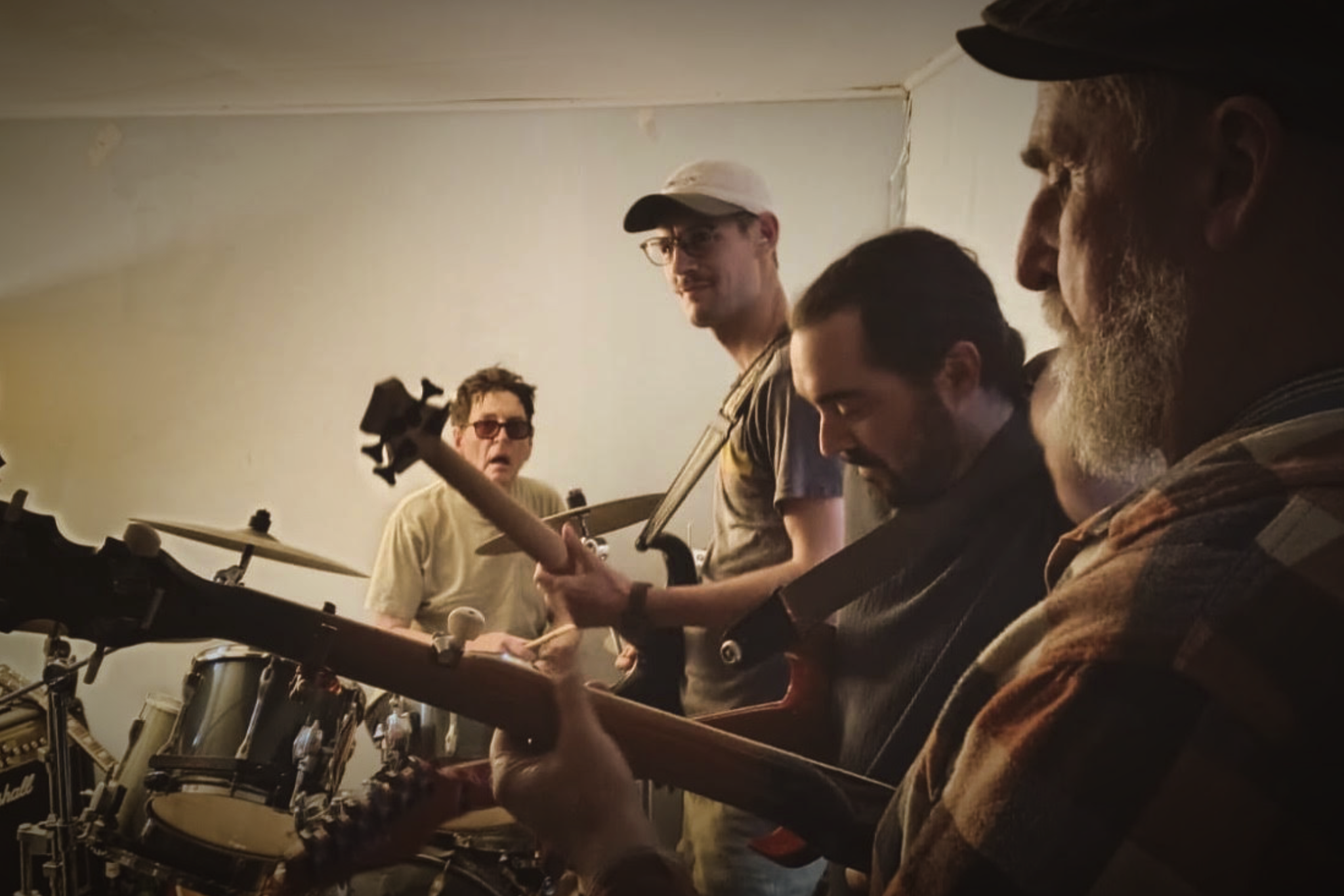
It was the next end of term, in June, that some friends and I kicked on at a pub in Kensington. We decided to head over to Rob’s, where he and our mutual friend Max were jamming in the shed. I saw the drum kit sitting in the back of the room and, in my drunken state, decided to rediscover my love of drumming. Rob was playing a heavy bass line tuned down; Max was experimenting with some higher frets. We just started feeling the music and created something special. There was an experimental funk rock style that seemed effortless to play. I could feel the rhythm return to my bones. I had reignited my love of playing.
Rob was a free-spirited individual. A poet and a majestic soul. Kind-hearted and open-minded in his approach to his work, his family, and his attitude to life. There was something captivating about his presence – his ability to converse on literature, philosophy, history, music, culture. I would find myself at ease talking to him. His words of wisdom, his capacity to connect deeply on issues of fatherhood, masculinity, and authenticity. I had met many characters over my life, but there was something truly special about Rob and his ability to connect with people. Charles Bukowski once observed that “the free soul is rare, but you know it when you see it – basically because you feel good, very good, when you are near or with them.” Rob was that rare free soul.
Credit: Thomas Meegan
We kept working together, and Rob started throwing parties. I would find myself on a Saturday evening rocking up to Rob’s with a six-pack in hand, talking to an eclectic group of individuals. I would make my way into the shed and begin playing experimental rock in his makeshift studio out the back of his house. The performance would be an improvised jam drawing influence from Kyuss, Nirvana, Sound Garden and every other seminal album from my suburban middle class adolescence.
The music would blare into the evening. I couldn’t understand how the neighbours wouldn’t complain, but I guess it was either the lack of concern or the lack of police presence.
I had heard of these DIY music scenes in New York, London, Paris, and how musicians would form around a particular space. The mythology of grunge was, in my mind, less about Seattle as a place than about a state of mind. When we played it wasn’t about structure or sound; it was about how we felt – an authentic expression. One of the more authentic expressions I had been lucky to be part of. In that shed, free expression itself became a loud act of liberty against the quiet pressures of ordinary life.
I changed jobs and moved schools, but I kept in contact with Rob. I would regularly hit him up for a beer on Friday in Footscray. He’s still keeping the scene alive from his makeshift studio with his motley crew of young musicians and veteran singer–songwriters. The power of the third space – away from work and family – where vulnerability through musical expression serves to integrate the sense of self and provide a sense of belonging.
I was reminded of the physicality of drumming. The lactic acid in my right arm would hit after ten minutes of heavy hi-hat rock beats before breaking into big shoegaze melodies. I would walk away from these evenings leaving everything on that drum kit, but the next day I would feel a sense of weight lifted from me. The burden of responsibility in modern life can wear heavy on the individual. In the perpetual balancing act of professional obligations, social norms, financial responsibility, and self-care, the individual must place themselves at the centre of these competing demands and find the ability to keep pace with the inner world and the outer world.
John Williams, in Stoner, describes a man slowly shaping a room and realising that “it was himself that he was slowly shaping, it was himself that he was putting into a kind of order, it was himself that he was making possible.” There is something truly special about spaces that bring people together. There’s something special about the people who create those spaces, like Rob. In this ever-changing society in which social norms continue to be imposed on us in both our professional and personal capacities, spaces for free expression become a source of regenerative drive. Only by making use of these shared spaces can individuals return to themselves, navigate the seasons of life, and move forward with meaning, humility, and love as their guiding virtues. ⚭
Thomas MeeganMore 2G4