Mise en Place
What happens when a people-pleaser develops an aptitude for home cooking? Tom Galvin ponders the joys of cooking for those you love.
March 2023: Two hours until my friends arrive. They’ll be on the train up from London by now. The chashu pork belly has been cooked for 24 hours in a water bath and is now cooling so it can be sliced and crisped up under the grill, served hot and still crackling. I check my Gantt chart, split into 30 minute sections. Pickled veg are done. Salt and pepper tofu is prepped and ready for final cooking. Ah. I should be skinning salmon and slicing into small wide strips, a good size for stir frying with XO sauce and subsequent consumption in he ye bing, known ubiquitously in the UK as bao (or, tautologically, as bao buns). The bao, made from scratch and pre-steamed the previous weekend, occupy most of two freezer drawers in our tiny flat kitchen, after a premeditated rundown and consumption of the drawers’ previous contents over the last few weeks. I will steam them in batches when my six guests arrive. My partner and I have no dining table in this flat, just a small shin-high coffee table around which six floor cushions have been positioned on the three sides not occupied by the sofa. All the dishes I am serving will just about fit on the coffee table; I did a dry run earlier with the specific serving vessels. Drinks may need to go on the floor but that is a problem for tomorrow, and eventually for the landlord.
September 2019: It is a Saturday. I fly to Vancouver on Sunday morning for a work conference. I arrive at the house in West Yorkshire early morning, long before the other guests do, to set up my portable pizza oven and to divide and portion the dough and generally make preparations. Toppings need slicing. The mozzarella really should be up to room temperature before baking. The marinara sauce is better if it sits a while to let the crushed garlic intensify in flavour. The 2G4 Editor (the ostensible host) and my partner at that time sit and fold 20-odd flatpacked pizza boxes I bought from a catering supply shop on ebay. It being the Editor’s birthday after all, we toast with a mid-morning glass of bubbly, before I am offered a drink of my choice from the Editor’s parent’s garden bar (at around 11:30 am). A longstanding fan, I ask for a Negroni, and explain the ratios and ingredients to the Editor’s dad who is new to making classic cocktails. What I am handed is approximately seven Negronis in a beer glass with a couple of ice cubes. It is thoroughly nursed and re-iced and interspersed with beers until the lunch is cooked and all the guests are sated, whereupon I steer into the pint of Bitter, not having had much of the lunch myself. Later, someone turns up before their shift in a bar and against better judgment leaves their golden retriever at the party until after they finish work in a few hours. Not wanting to be remiss in my duties, I drunkenly pack the dog with so many crispy-coated peanuts and pass out somewhere upstairs. The flight on Sunday is horrendous.
—
I first fell in love with cooking when I realised it could impress women. I’d baked and cooked a bit with my Mum as a kid, burnt sausages on a barbecue with my Dad before but it wasn’t until early sixth form when I cooked a meal (some sort of amatriciana-adjacent dish I recall) for my then girlfriend that I realised the power of cooking for someone close to you. It’s that last bit that is important. Cooking is a necessity for most, cooking is a job for a lot of people (paid or otherwise), cooking can be like any other household chore, but choosing to do it for someone or some people that you care about, and putting a bit of extra effort in while you’re at it turns the whole thing into an expression of love that far transcends the base of Maslow’s hierarchy.
“Cooking can be like any chore, but a bit of extra effort turns the whole thing into an expression of love”
—
July 2010: In Sixth Form three of my more culinarily-inclined friends and I decide to run our own version of the show Come Dine With Me. I am to host first, and it is my first time cooking for more than two people (my parents, who have cleared out for the night). Having visited India a few months prior, I opt for these flavours on my menu. I do my very best to go all out. The table that greets them has ice-cold Kingfisher beer and bowls of home-made bombay mix (extruded precariously into boiling oil from a small sev sancha I picked up in Madurai). What follows are koftas, raita and naan breads, a chicken jalfrezi, pilau, and a righteous lamb biryani. To finish, the sucrosic one-two punch of pistachio kulfi and warm carrot halwa. We play Indian poker (different ‘Indians’) and bet with shots of gin late into the night. I win the competition. A hollow victory however; despite only praise for the meal, I lost points from two of my friends for spending most of the night in the kitchen. They would have liked to have had more time with me, their friend, that evening, because really that was the whole point of the undertaking.
—
Me and that girl from sixth form didn’t last so long, but there would be other girlfriends on the horizon, therefore more opportunities to win them over with tasty meals, and actually I should probably cook for my parents now and then to practice so I can really properly impress these women, because everyone that’s tried my food so far has said it’s genuinely quite nice but they’re probably just being polite, or kind, or didn’t want to make a fuss, and actually I really need to cook this dish about five times for myself before I’d ever dare serve it to someone whose opinion I valued because it would put both of us in a really awkward position if the food was bad, and I’d hate to do that to someone I cared about almost as much as I’d hate to have to smile and listen to fake pithy compliments from the person about the food that we both know is bad but neither of us will acknowledge, because that would just be awful, anyway it’s okay though because I’ll keep practicing beforehand until I nail it, all the cooking work doesn’t feel so much like work actually, I really enjoy it, I think, I really do just enjoy cooking for cooking’s sake and maybe it doesn’t all have to be about results and impressing people, although it is a nice side effect. No. The food cannot be bad, that’s all that matters.
—
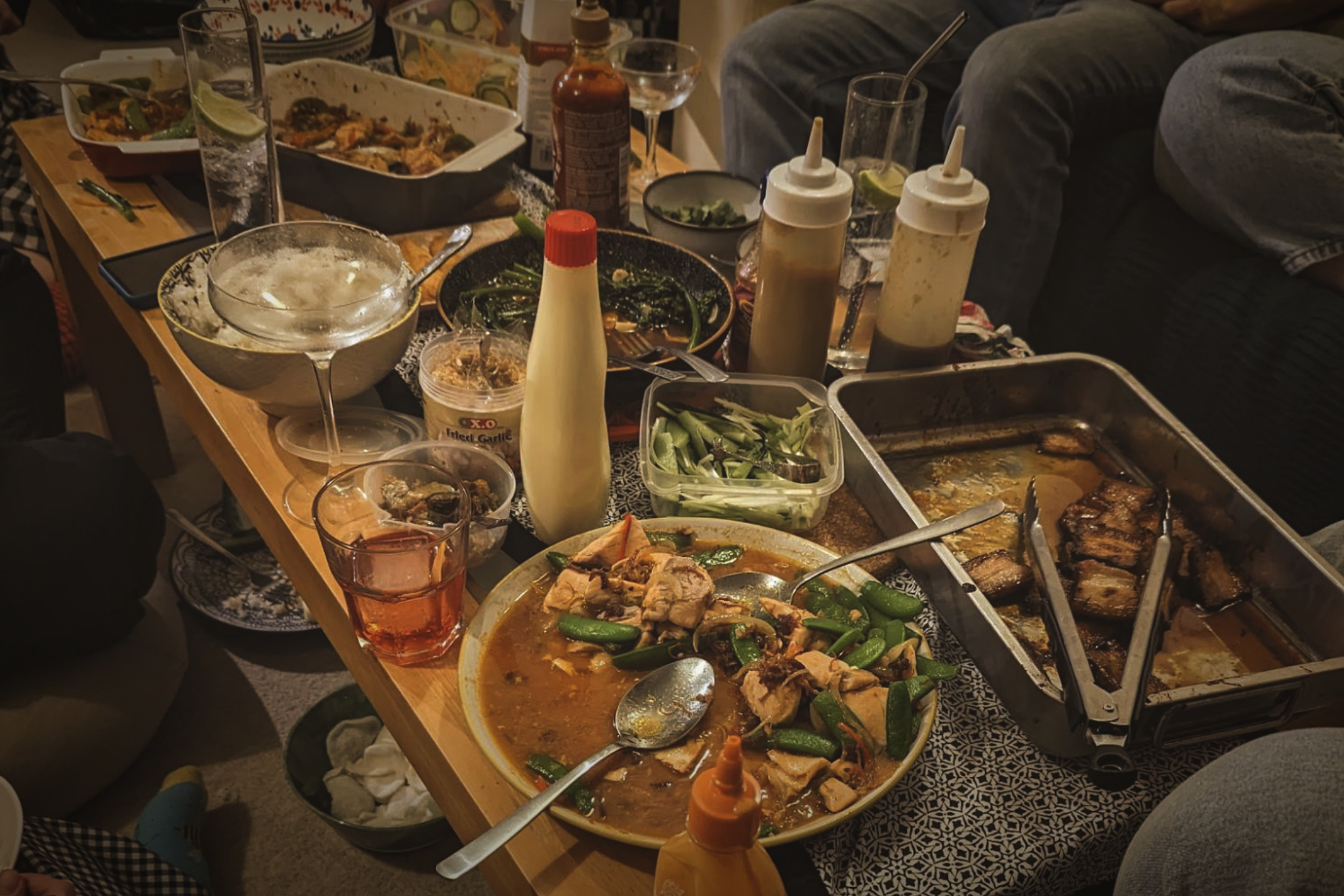
February 2025: Although my partner and I moved into our house in the middle of 2024, this is our first time hosting a proper dinner party. It took a while to unpack and get the furniture in: a big sofa, an old dining table which can extend to seat a lot of people. Chairs from ebay and some auxiliary folding ones from Ikea. We got the house primarily for the size of the kitchen and its open-plan ground floor, which make it a perfect space for hosting. A few colleagues of mine are coming over for the first time, most of them more colleagues than friends at this point; something I hope the evening will start to remedy. The spread leans Palestinian tonight, gorgeous purple musakhan split with pale olive oil and vibrant green dagga Gazawiyyah. There is lavash and hummus, my colleague brings baba ganoush. A fattoush and a vaguely Levantine chickpea stew play second fiddle, and everything is brought together with a giant pot of humble m’jadarra bejewelled with pomegranate seeds and chopped parsley. Cocktails and wine loosen everyone up and we have a great night. One guy introduces us to a parlour game that will later become known as ‘Fancy Dan’, and become a mainstay of our future evenings together. My colleagues leave in the early hours, well fed and well on the way to not just being coworkers.
Credit: Tom Galvin
—
Once the hormones started to settle down I emerged from the horrors of adolescence as a half-way decent cook with a keen palate, and healthier opinions about women. It finally occurred to me that rather than trying to just show off to people with food, it was actually just a beautiful thing to do for those you love, romantically or platonically (or even for xenia). The fact we all need to eat should bring us together; the word companion (as well as the cognate company) is ultimately derived from the latin for ‘with bread’, i.e., people you would share food with. That always seemed so profound when I was younger and it still resonates today. When I moved to university, I was surprised at the disparity in cooking abilities of my flatmates. Not in a snobby or judgmental way you understand, more that a lot of people genuinely found cooking a quotidian slog, and didn’t experience the joy that I did. That comes with the territory for all obsessive hobbies really, everyone likes what they like and that’s fine: start talking about football to me and watch how quickly I make a face. But food felt different, more important. Eating was essential, and I felt like I was stealing joy from the aether where others came up scarce. It wasn’t long before I was cooking for my flatmates and coursemates, encouraging group meals where we’d all chip in for the ingredients because we were all always skint.
Despite a love of cooking and a lack of money, at university my friends and I still ate and drank out all the time. Food with friends was still food with friends whether one of us made it or not. Even now after many years of full time employment and salary, the frequency at which we would eat in restaurants, takeaways and bars seems unachievably extravagant in a post-COVID economy. We obviously weren’t fine dining all the time with iced buckets of Bollinger, more like a Nando’s and a bucket of 15 VKs but it still seems crazy. Today, I have friends that are different ages and in different stages of their life, and more importantly in different economic situations. To see them all at the frequency I would like would be prohibitively costly if we only went out for dinner or a night out. Hospitality in the UK is unfortunately on its arse and it means, in a self perpetuating cycle, we can all visit those spaces together less often.
—
May 2026: We arrive at an airbnb in the peak district for my friend’s stag do. I’ve travelled with the stag, and the car is full to the gunwales with us, a barrel of beer and a multitude of shopping bags laden with ingredients. When organising the weekend with the best man, he initially protested at my suggestion that I cook most of the meals the nine of us will eat. He is worried I’ll be trapped in the kitchen the whole time, that I won’t be able to have fun with the rest of the group. I have only met him once or twice before so he does not know me well. I reassure him I love this, and that I planned (with the Editor) a weekend of food for a Centre Parcs getaway for 7 of us and it turned out brilliantly, and more importantly, far cheaper than eating out all the time (the one time we did eat out at centre parcs cost almost as much as what we spent on ingredients for the rest of the stay). I tell him the menu will be based around prep and therefore light on kitchen time, and I will deputise people as and when needed to share the load. The next day I add the draft menu and shopping list to our shared planning document and his concerns turn to anticipation. It’s my first time meeting 4 of the 9 attendees. They’ve all heard of me, they tell me; the stag has said I will outdrink all of them, and that my food will be excellent. I’d have preferred he share those tidbits in a different order, but over the course of the weekend I prove him right on both counts. We eat elotes-style corn ribs, padron peppers, and tortilla chips with the requisite dips. Then, tacos. Beef shin birria is served, carne al pastor, baja halloumi ‘fish’ (the stag is the sole vegetarian), lacto-fermented squash with goat's cheese and refried beans. Quorn enchiladas. Pastel de tres leches for sweet. A monster fry up on the first morning, french toast, fluffy pancakes on the next day, and pizzas in the property’s outdoor oven which are cooked standing in very light rain. People offer to help and of course I let them, the more the merrier, but all that needs doing is chopping and peeling and slicing of the fresh veg and garnishes. There are moments in the kitchen bereft of conversation, punctuated by the simultaneous polymetric banging of the property's blunt knives against chopping boards, smashing through lettuce or peppers. As my gift to the happy couple, I made the wedding cake.
“A first space for me, but a third space for us”
—
I'm privileged enough now to not have to ask people to chip in financially when I host a dinner party. Don't get me wrong, there's nothing at all bad about doing that; the food I serve is not at all intended to be a Gatsby-esque display of wealth and opulence. It's certainly consumption but in no way is it supposed to be conspicuous. I’m able to, and I love my friends so why wouldn't I do what I can for them? Of course they'll bring the wine and sometimes a dish or dessert. And have I mentioned already how much I love the cooking bit? Our home has become the dinner hangout spot for our mates that live locally, and I cook for them about every two months. Aside from the fun I have in the kitchen, it's glorious that I can anchor my community inside my own home, a first space for me but a third space for us. And of course I'm not above admitting a (not insignificant) part of me still does love to try and impress, to show off in both volume and complexity of the fare, but that's by no way the main reason anymore (or so I tell myself).
—
December 2025: My colleagues and their partners join me and my partner for a Christmas dinner at our house. Almost every year at university (and I was there for eight of them) I would cook a flat-Christmas, or flatmas dinner for my housemates. It’s a tradition I miss and one I hope to reignite with my colleagues. Actually, to just call them colleagues at this point does our genuine friendship a disservice. Prior consensus could not be reached on a festive meat between the nine of us, so I have cooked four (beef, chicken, gammon and duck). I have taken days off work to prepare for this, so I can be present in the evening with my friends. In the spirit of the season, and to prove to them as much as to myself that I am not an egomaniac or a control freak, everyone has brought a contribution to the meal. My Polish friend brings a tradition from her homeland, oplatki: small wafers embossed with the nativity that are broken up and exchanged with the other guests to eat, along with well wishes and good fortunes for the new year. After an awkward start, everyone begins to speak from the heart, and another of my friends becomes verklempt at all the genuinely nice things being said about one another. The meal starts with another Polish festive dish courtesy of my friend; barszcz czerwony z uszkami, followed by a second soup, my butternut squash and brown butter velouté. The main event is a truly colossal quadracarnic roast dinner, bolstered by everyone’s collective trimmings. There are both roast potatoes and pommes confit. A good 2 kg of cauliflower cheese (it’s not traditional!). Several hours of drinking and games and Christmas gifting go by before we can even think about my friend's brownie yule log and my duo of homemade ice-creams. They are a wonderful bunch; we’ve since had them over for Orthodox Easter (Pascha) this year, where I honoured my birth nation by cooking them an Olympian cornucopia of Greek delights, as well as for a giant barbecue, and a pizza night for one of England’s world cup games.
November 2011: One of my flatmates and dear friends is in a bad way. A rugby incident has left him with his dominant hand in a cast and wires sticking out of his thumb for a couple months. A messy break-up of his long term relationship over the summer continues its death throes. He can just about go to the toilet by himself (thankfully) but most bimanual tasks are outside of his current capabilities. His sadness is palpable. We are on the same course so I assist him with his rucksack and notepad in lectures. I help him put the bag over his cast before he showers. I do up his trouser button and fly and fasten his belt on a morning. Of course I cook for him as well. No frills (we’re skint), no showing off (he’s a he), just weeknight fare. We concoct (him overseeing) a chicken and beef pasta dish we dub “Linguine Chicken Bovine” (pronounced alternatingly Ling-wine Chick-ine Bovine, or Ling-weenie Chick-eenie Bov-eenie, depending on mood) that ends up becoming a staple for months to come. One night I make us enchiladas from a kit, but of course I tweak the spices and I add extra stuff and take a bit of care in their preparation. I bring the hand-me-down pyrex to the table and plate him up a couple. He awkwardly mashes a bit off with a fork, southpaw. For the first time in weeks, a genuine smile. He says they’re the best meal he’s ever had. ⚭
Tom GalvinMore 2G4